Few lightsabers have a history quite like the one fans commonly call the Graflex. Its story begins with an unlikely object: a camera flash handle. That piece of photographic equipment was modified with parts from other everyday objects and transformed into one of the most recognizable props in movie history.
But the Graflex is more than an interesting piece of filmmaking history. Within the Star Wars story, the weapon has passed from Anakin Skywalker to Obi-Wan Kenobi, Luke Skywalker, and eventually Rey. It has been lost, recovered, buried, broken, repaired, and passed between generations.
The physical props used to portray it have their own history, too. This is the story of both.
The Graflex lightsaber is the name commonly used by fans and collectors for one of the most recognizable lightsaber designs in Star Wars. The name "Graflex," however, does not come from the fictional universe. It comes from the real-world object used to create the original prop.
The original lightsaber prop for Star Wars Episode IV: A New Hope was built around a Graflex camera flash handle. The metal handle already had many of the characteristics that made it convincing as a lightsaber hilt, including its proportions, weight, clamp, buttons, and other mechanical details.
The production modified the flash handle with pieces from other objects, transforming photographic equipment into a weapon. That basic design became the foundation for the blue-bladed lightsaber associated with Anakin Skywalker, Luke Skywalker, and, decades later, Rey.
"Graflex" is therefore best understood as a real-world name for the prop design, not the name of the weapon itself.
Graflex was a company known for cameras and photographic equipment, including flash attachments with metal handles. One of those handles became the foundation for Luke Skywalker's lightsaber.
The connection is why fans began referring to the hilt as the Graflex. The term eventually became common among collectors, prop enthusiasts, and lightsaber builders.
It is also worth making a distinction between a Graflex flash and a Graflex lightsaber. Genuine Graflex photographic equipment existed independently of Star Wars, and not every Graflex flash was converted into a movie prop.
The Graflex lightsaber was created at a time when the visual identity of Star Wars was still being developed. Set decorator Roger Christian was looking for objects that could help give the film's futuristic world a sense of reality. Rather than relying exclusively on purpose-built science-fiction props, the production frequently repurposed ordinary objects and industrial equipment.
Christian has described the discovery himself. While looking for parts at a camera shop, he asked the owner whether he had anything unusual that might have something to do with cameras or flashes. The owner directed him toward a collection of dusty boxes that had not been opened in years. The first box Christian pulled out contained a Graflex flash.
He immediately recognized its potential. It had the right size and weight, along with buttons and other mechanical details that made it look like it could already be some kind of piece of equipment. Christian later described the discovery as finding the "holy grail." He took it back to the studio and began experimenting.
The Graflex handle was not simply used as-is. Christian added rows of T-shaped strips around the handle. He had previously used the same type of material on the handle of a stormtrooper weapon.
He also had broken-down calculators available as a source of parts. One component caught his attention: the small bubble strip that illuminated and magnified the numbers on the display. It fit perfectly into the Graflex's clamp.
Finally, Christian added a D-ring to the bottom of the handle so that Luke could carry the weapon on his belt. The transformation was remarkably simple. A camera flash had become a lightsaber. Christian then showed the result to George Lucas. According to Christian, Lucas simply held the prop and smiled. For Christian, that was all the approval he needed.
Christian ultimately made five or six of the lightsaber props for the production, with some sent to Tunisia for filming and another used for the scene in which Obi-Wan gives the weapon to Luke.
That is one of the most remarkable parts of the Graflex's history. One of cinema's most recognizable weapons began with a dusty box in a camera shop.
The Graflex wasn't chosen simply because it happened to make a good lightsaber. Its use reflected one of the defining visual philosophies of the original Star Wars: the galaxy was supposed to look used.
Technology in the films rarely looked brand new. Ships were dirty and patched together. Droids showed signs of wear. Weapons and equipment looked as though they had been handled, repaired, and modified over years of use. The lightsaber fit perfectly into that world.
The Graflex already looked like a functional piece of equipment before Christian modified it. That gave the finished lightsaber something that a completely fictional design might have struggled to achieve: authenticity. The exposed hardware, mechanical clamp, mismatched components, and worn metal made it look as though it had a practical purpose.
The audience didn't need an explanation for every piece. It simply looked real. That same philosophy can be seen throughout the original trilogy, from the Millennium Falcon to the weapons carried by the characters. The technology of Star Wars wasn't meant to look as though it had just rolled off a futuristic assembly line. It was supposed to look as though people had been living with it.
This approach also allowed the production to create an enormous amount of visual detail without manufacturing every object from scratch. A camera flash could become a lightsaber, an existing piece of hardware could become part of a blaster, and a collection of ordinary objects could become something that looked completely at home in another galaxy.
The Graflex is perhaps the clearest example of that philosophy because its original identity remained hidden in plain sight. The audience was looking at a piece of photographic equipment; they just didn't know it.
The physical props used to portray the Graflex changed from production to production, but within the story, the weapon itself has a continuous history. This is the fictional history of the Skywalker lightsaber.
Anakin Skywalker carried the blue-bladed lightsaber throughout the Clone Wars. It became one of the defining symbols of Anakin as a Jedi Knight, accompanying him through years of battles for the Galactic Republic.
After Anakin became Darth Vader, he and Obi-Wan Kenobi faced one another on Mustafar. Obi-Wan defeated his former apprentice and took Anakin's lightsaber. The weapon that had belonged to Anakin was now in the possession of his former master. Obi-Wan kept Anakin's lightsaber on Tatooine for nearly two decades before eventually giving it to Luke.
The Obi-Wan Kenobi series adds another chapter to the weapon's history. During his years in hiding, Obi-Wan buried two lightsabers in the sands of Tatooine: his own and Anakin's. The symbolism is hard to miss. Anakin's lightsaber, once carried through the Clone Wars and the fall of the Jedi Order, was buried on the same desert world where Anakin had spent his childhood. But the weapon would eventually leave the desert again.
Years later, Obi-Wan gives Anakin's lightsaber to Luke. At this point, Luke doesn't know the full truth about his father. To him, it is a connection to Anakin Skywalker and the Jedi past that Obi-Wan is introducing him to. The weapon becomes Luke's first lightsaber and accompanies him through the early stages of his journey. It is the weapon audiences first saw in A New Hope, and it remains with Luke through The Empire Strikes Back.
During Luke's duel with Darth Vader on Cloud City, Vader severs Luke's hand. Luke survives, but the weapon disappears, and for years its whereabouts are unknown.
By the time of The Force Awakens, the lightsaber has ended up in the collection of Maz Kanata. Exactly how it traveled from Cloud City to Maz's castle remains one of the mysteries surrounding its history.
In the original script, JJ Abrams detailed the hilt’s journey from Cloud City to Maz Kanata’s possession, but the segment got cut to keep some mystery in the years between Return of the Jedi and The Force Awakens. What matters is that the weapon eventually finds its way into Maz's possession. Then Rey discovers it.
When Rey encounters the lightsaber in Maz's castle, the weapon triggers a series of visions connected to its past. She initially hesitates to take it but eventually accepts it. By the end of The Force Awakens, Rey is carrying the same, blue-bladed weapon once wielded by Anakin and Luke. The weapon has found another generation.
In The Last Jedi, Rey and Kylo Ren struggle over the weapon aboard the Supremacy. Neither will let go. Both use the Force to try to gain ownership of the lightsaber, pulling it in opposite directions until the hilt is torn apart. For a moment, it appears that the Skywalker lightsaber has finally reached the end of its journey, but the writers had other plans.
By The Rise of Skywalker, Rey has repaired the weapon. The damage isn't completely hidden. The repaired hilt retains visible evidence of what happened to it, turning the physical condition of the prop into another part of its story.
Behind the scenes, Lucasfilm's prop team deliberately reinforced that idea. The *Rise of Skywalker* version was machine-tooled to recreate the Graflex-based design, and the prop makers added burned-in soldering marks along with a new metal-and-leather piece joining the broken halves.
At the end of The Rise of Skywalker, Rey returns to Tatooine. Near the Lars homestead, she buries the lightsabers belonging to Luke and Leia. The Skywalker lightsaber has come full circle.
It began with Anakin, passed through Obi-Wan and Luke, disappeared for decades, and eventually became part of Rey's story. Now it is returned to the desert world where the Skywalker saga began. Rey then reveals a new yellow-bladed lightsaber of her own. The Skywalker lightsaber's journey, at least for now, is over.
The fictional weapon remained the same, but the physical props used to portray it did not. As Star Wars moved from one production to another, new versions of the Graflex design were created for different actors, filming requirements, and visual-effects techniques. The basic silhouette remained recognizable. The actual props evolved.
A New Hope established the Graflex design audiences would come to recognize. There were multiple physical props, however, and not all were built identically. One particularly interesting version was the special-effects prop used for the spinning-blade effect. Rather than being a conventional Graflex flash handle, it was constructed from a piece of pipe dressed to resemble the Graflex design.
The Graflex design returned with Luke in The Empire Strikes Back, but the prop's story did not simply freeze in place after the first film. The production used additional versions of the hilt, with differences in construction and details reflecting the needs of the sequel.
This is also where the question of surviving original props becomes particularly complicated. Some Graflex-based props have been associated with more than one production, while others were recreated or modified for specific filming requirements. The result is a family tree of related props rather than a single object that can be traced through every film.
The prequel trilogy created a particularly interesting challenge. For the first time, audiences would see Anakin Skywalker carrying the weapon before it became Luke's. The production therefore needed a new physical version that looked like the same fictional lightsaber, just newer.
The Revenge of the Sith hero prop was custom-made as a copy of the original Graflex-style design. It was constructed from resin with a vacuum-metalized chrome finish and made slightly smaller than the original trilogy version so Hayden Christensen could handle and fight with it more easily.
Rather than being the original Graflex prop, it was a new physical reproduction of the established design. The differences are easy to miss because the production team went to considerable lengths to make the two versions look like the same weapon.
When the Graflex design returned for The Force Awakens, it had to bridge nearly four decades of filmmaking history. The weapon needed to look like the same lightsaber audiences remembered from the original trilogy while also being practical for a new production and a new protagonist.
The result retained the familiar visual language of the original: The clamp, the buttons, the ridged grip, the overall shape. To the audience, it was Anakin's and Luke's lightsaber. Behind the scenes, it was a new generation of the prop.
The Last Jedi gave the physical prop another important chapter. During the struggle between Rey and Kylo Ren, the hilt was torn apart. For the story, this was the destruction of the Skywalker lightsaber. For the prop department, it created an opportunity to design something that could later show the weapon's damage.
The repaired version seen in The Rise of Skywalker was deliberately designed to preserve that history, with one augmentation. Lucasfilm's archive notes that the new prop was machine-tooled according to the established specifications, while the original New York manufacturer stamp was omitted. Prop makers then added burned-in soldering marks and a metal-and-leather section to join the two halves.
The result looks less like a pristine replica and more like a family heirloom that has been repaired by someone who had limited tools and a reason to keep it alive. In other words, it looks exactly like something Rey would have made.
The surviving Graflex props are fascinating because there isn't a simple answer to the question, "Which one is the real Graflex lightsaber?" There were multiple production props, and surviving examples have different histories.
The original prop began with a commercially produced Graflex flash handle. That means genuine Graflex photographic equipment exists independently of Star Wars. Finding an old Graflex flash does not mean finding a movie prop. The modifications, construction details, and provenance are what make an individual example significant.
This has become especially important for collectors because the Graflex design has been reproduced countless times.
One of the most interesting surviving examples was sold through Prop Store. The production-made lightsaber originated from Andy Mitchell, whose father, Andrew Mitchell, was managing director of Elstree Studios when the original Star Wars films were made.
Mitchell recovered the prop from the Elstree backlot after production and was allowed to keep it as a memento. The prop contains several features consistent with the production design, including a D-ring, a seven-bubble lens strip, and evidence that the T-shaped grips had once been attached. It also contains an unusual, welded metal plate inside the emitter, apparently added to help mount a blade.
But there is an important caveat. Prop Store specifically identifies this as a production-made lightsaber, not the famous hero Graflex seen in the best-known production photographs and not the documented spinning-blade effects prop.
The location of those two particularly well-documented props is not currently known. That makes the surviving Mitchell example an especially interesting piece of the original prop's history, even if it cannot be identified as the primary hero weapon.
Because the Graflex design is relatively straightforward to reproduce, physical appearance alone isn't always enough to establish that a prop came from the production. Documentation, provenance, construction details, and a credible chain of ownership can be just as important as the prop's appearance. The story of the Graflex therefore extends beyond Star Wars filmmaking. It has become part of the history of movie-prop collecting.
There are plenty of memorable lightsabers in Star Wars, but the Graflex occupies a unique position. Its popularity isn't simply because it belonged to Luke Skywalker. The design itself became iconic.
Few objects in the saga connect Anakin, Luke, and Rey so directly. For Anakin, it is the weapon of a Jedi Knight. For Luke, it becomes a connection to the father he never knew and his introduction to the Jedi path. For Rey, it represents a legacy that she inherits before eventually deciding what that legacy means to her. The same fictional weapon therefore represents three very different characters and three very different eras of the Skywalker story.
The Graflex never looked like a perfectly manufactured science-fiction weapon. Its collection of mismatched components make it look as though someone assembled and maintained it over time. That visual quality became even more appropriate as the fictional weapon accumulated its own history. It was carried through wars, lost, recovered, buried, broken, and repaired. The prop looked as though it had lived a life because the story eventually gave it one.
There is a remarkable parallel between the two histories. In the real world, Roger Christian took an existing object and transformed it with whatever useful parts he could find. Later productions recreated and modified the design rather than treating the original physical object as something that had to survive unchanged.
In the fictional universe, the weapon passed from one person to another, accumulating meaning without losing its identity. In both cases, the history remains visible. That may be the biggest reason the Graflex has endured. It wasn't designed to become a legend; it simply became one.
The Graflex design has survived far beyond the original films. Its familiar combination of metal construction, clamp, buttons, and ridged grip has made it one of the most recognizable lightsaber designs for collectors and enthusiasts.
Modern lightsaber makers have interpreted the design in many ways. Some aim for close recreations of the classic appearance, while others use the Graflex as a starting point for custom finishes, electronics, sound systems, and modern blade technology.
Ultrasabers offers several interpretations of the classic Graflex design, including the Graflex CE, the Graflex SE, and the Dark Graflex.
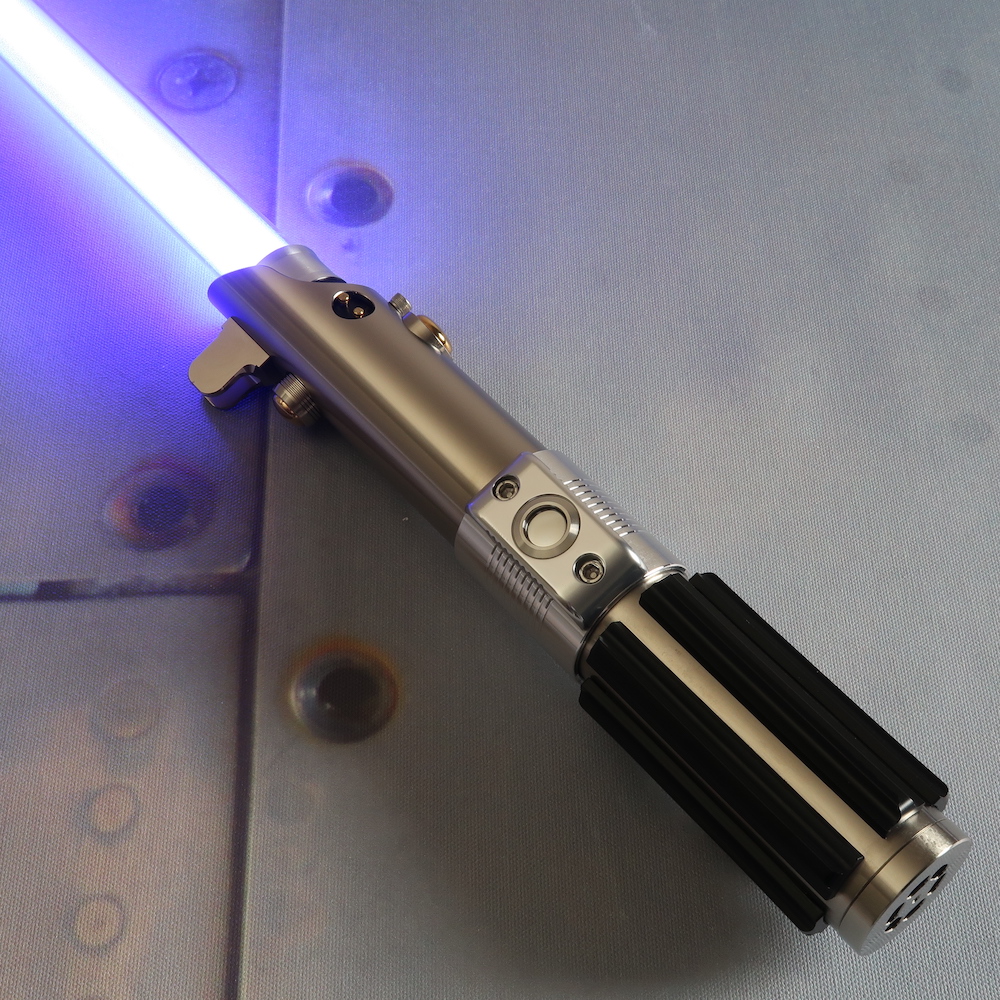
Original price was: $265.00.$225.25Current price is: $225.25.
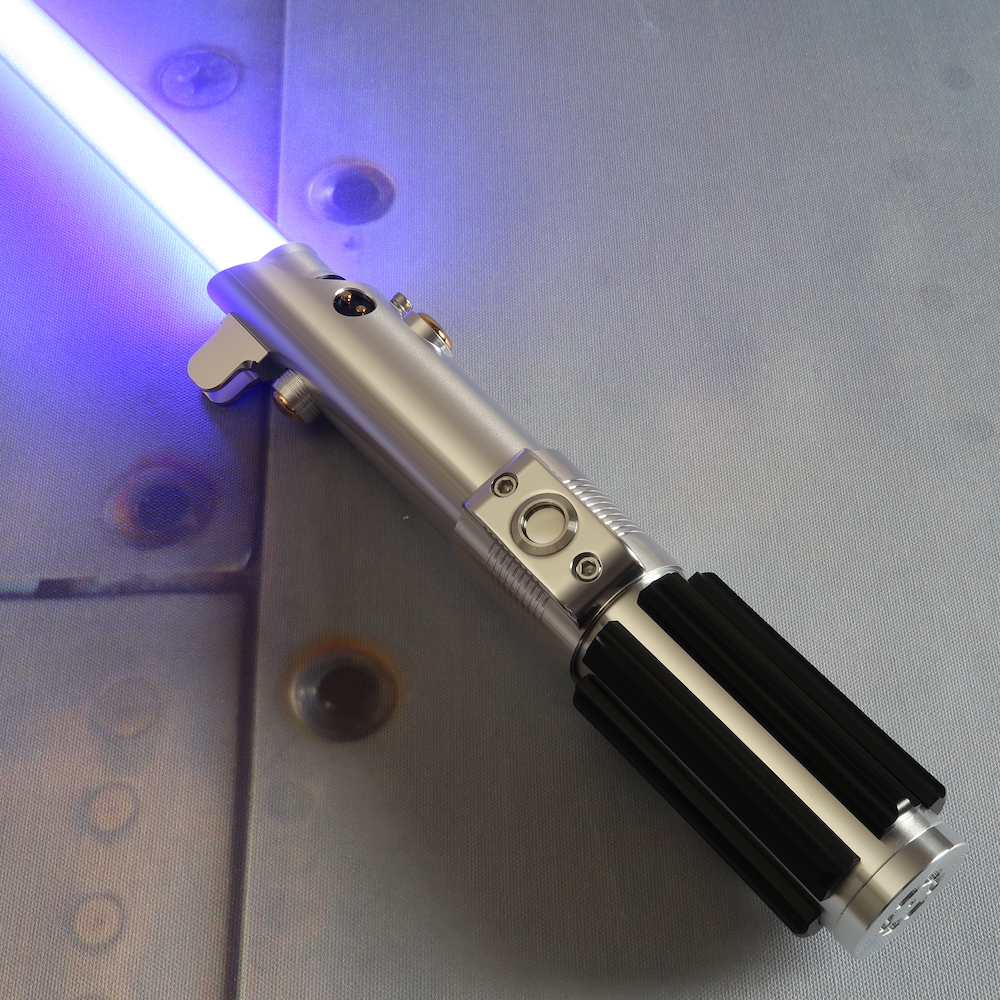
Original price was: $240.00.$204.00Current price is: $204.00.
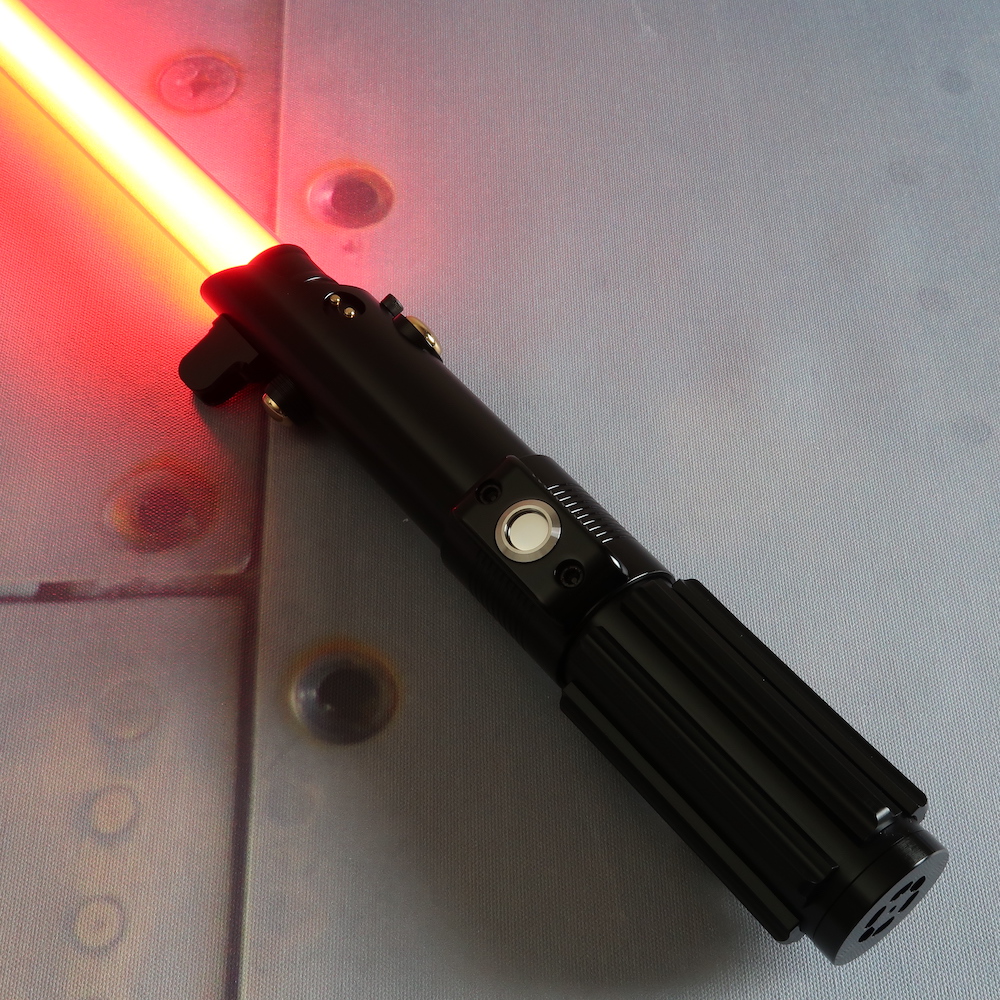
Original price was: $240.00.$204.00Current price is: $204.00.
Each takes a different approach to the familiar design while retaining the characteristics that make the Graflex recognizable.
A Graflex lightsaber is the fan and collector name for the lightsaber design originally created using a Graflex camera flash handle. The original prop was modified with pieces from other objects to create the familiar hilt.
Luke's lightsaber is called a Graflex because the original A New Hope prop was built around a Graflex camera flash handle. "Graflex" is a real-world name associated with the prop, not the weapon's name within the Star Wars universe.
Yes. The original lightsaber prop was built with a Graflex flash handle as the primary part of the hilt. Roger Christian modified it with additional parts to create the lightsaber.
Roger Christian created the original Graflex-based lightsaber prop for A New Hope. He used the flash handle as the foundation and added parts from other objects to complete the design.
Within the story, the Skywalker lightsaber has been used by Anakin Skywalker, Obi-Wan Kenobi, Luke Skywalker, and Rey. It has also been temporarily possessed by other characters during its journey.
Luke's first lightsaber, yes. Within the story, Luke receives the same lightsaber that previously belonged to Anakin. Obi-Wan takes Anakin's weapon after Mustafar and later gives it to Luke. After losing the Graflex lightsaber on Cloud City, Luke builds a new lightsaber similar to Obi-Wan’s.
The Skywalker lightsaber has a blue blade when used by Anakin, Luke, and Rey.
No. Rey's yellow-bladed lightsaber at the end of The Rise of Skywalker is a separate weapon that she constructed for herself.
The Graflex lightsaber has one of the most unusual histories in movie history. It began as a camera flash handle, became a movie prop, and eventually became one of the most recognizable weapons in cinema. Within the story, it became Anakin's, then Luke's, and finally Rey's.
Behind the scenes, it was recreated, rebuilt, and reinterpreted across generations of filmmakers. The fact that such an iconic weapon began with an ordinary piece of photographic equipment is part of what makes it so fascinating. The Graflex wasn't necessarily designed to become legendary. It just did.


